Build-Operate-Transfer fails in the Transfer. Here are the gates to negotiate at signing.
BOT engagements rarely fail while a vendor is building. They fail when nobody defined what 'stable' means, who owns the accounts, or why the vendor would ever let go. The scorecard, the ownership matrix and the terms that fix it.

Praveen Kumar
Founder & Technology Leader
On this page
Build-Operate-Transfer sounds like the engagement model with the least risk. A vendor builds your product and your team, runs both until they are stable, and hands them over. You get a working system and the people who know it, without a year of hiring before the first line of code.
I have been on both sides of it: inside large companies that commissioned it, and now as a vendor who offers it. The build phase almost never fails. The operate phase sometimes drifts. The transfer is where it goes wrong, and it goes wrong for three reasons that are all visible on day one if you look: "stable" was never defined, nobody mapped who owns the cloud accounts, the domains and the on-call rota, and the vendor's commercial incentive points away from ever finishing.
This article is the set of gates, lists and terms we ask clients to put in the contract before we sign it, including with us. The templates are in our engineering notes repository.
Why the T breaks
The trigger is a feeling. Most BOT contracts say transfer happens "once the platform is stable" or "at the end of month eighteen". The first is unmeasurable, so the conversation about readiness becomes a negotiation about opinions. The second arrives whether or not anyone is ready, and the vendor's engineers are the only ones who can keep the lights on, so the date slips with an extension invoice attached.
Ownership was never mapped. The cloud organisation was created under a vendor email. The domain registrar account belongs to a vendor engineer who has since left. The app store accounts, the signing keys, the observability subscription, the pager tool: eighteen months in, nobody can list them, let alone transfer them. Discovering this in the transfer week turns a handover into an archaeology project.
The incentives are wrong. A vendor on a day rate earns more the longer transfer takes. Nothing in the contract rewards finishing. Good vendors transfer anyway, out of professional pride and the hope of a reference. Structure should not depend on that.
Define transfer as gates, not a date
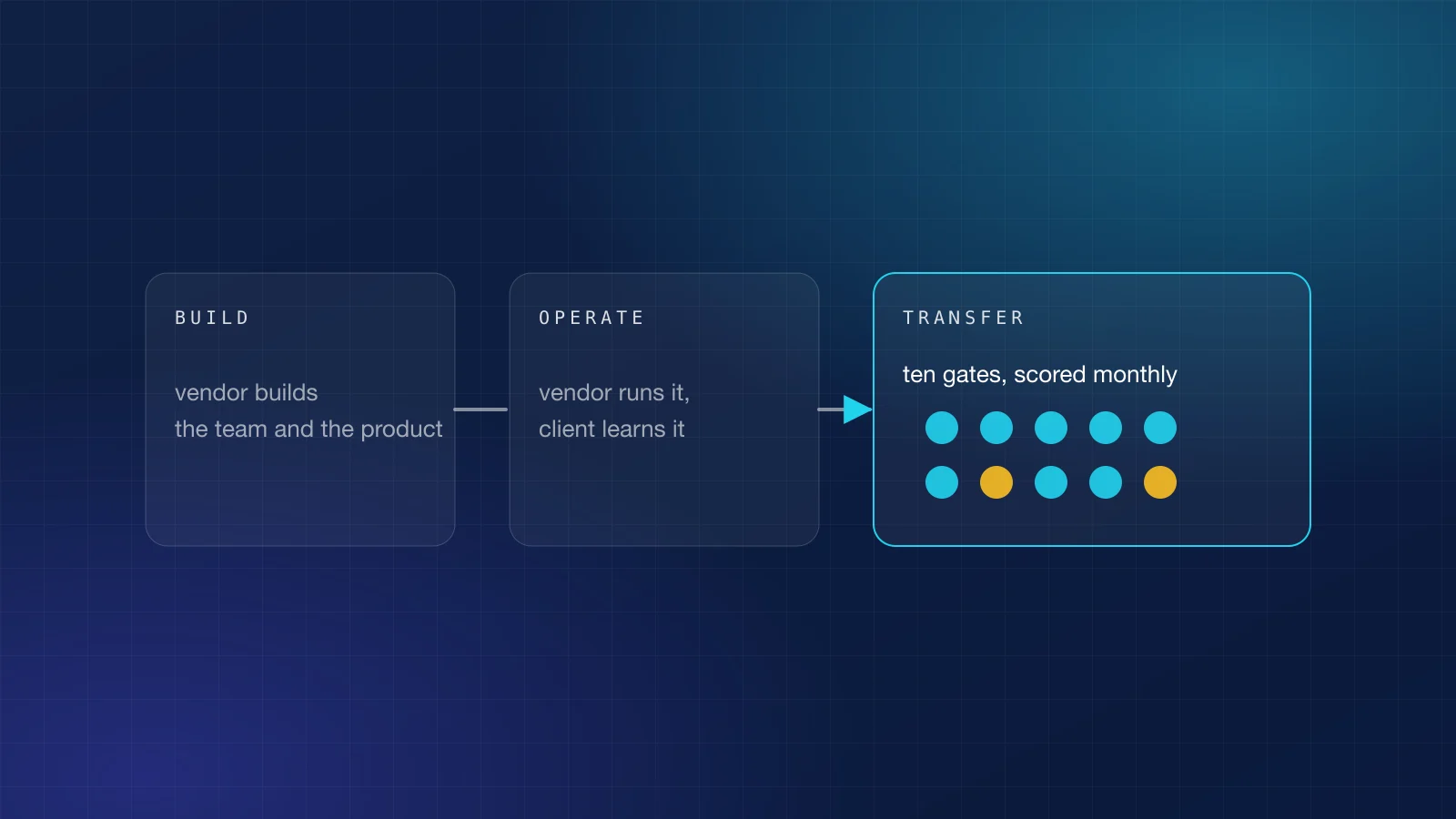
The fix for the first problem is to write down what ready means, in terms that can be scored. We use ten gates. Agree the thresholds at signing, score them monthly from month one in the same meeting as the delivery review, and start transfer when every gate has been green for two consecutive months.
| Gate | Threshold |
|---|---|
| Bus factor | Every critical system has at least two client engineers who shipped a change to it in the last 90 days |
| Deploy without the vendor | The client team has run a production deployment and a rollback end to end with no vendor engineer present |
| On-call | The client staffs the rota; vendor engineers are escalation only, with a share that declines each month |
| Runbooks | Every alert that paged in the last quarter has a runbook a client engineer has used |
| Incident ownership | The last two incidents were led and written up by client engineers |
| Hiring pipeline | Open roles for the team are owned, posted and interviewed by the client |
| Access | The vendor holds no standing admin on cloud, identity, source control, DNS, secrets or app stores; break-glass access is time-boxed and logged |
| Knowledge | Architecture decisions, the system map, data flows and vendor contracts are in the client's wiki and have been reviewed by a client engineer |
| Budget | Cloud and SaaS spend is billed to client-owned accounts and reviewed monthly by a client owner |
| Velocity without the vendor | Delivery metrics stayed within agreed bands during a two-week window with vendor engineers observing only |
Each gate has evidence attached: commit history by person, deployment logs with names, rota exports, postmortems with authors, an access review. The monthly scoring takes thirty minutes and produces the only honest answer to "are we ready?". A gate that is red for two months in a row is an escalation, with a named action and an owner, not a surprise at month seventeen.
Notice that six of the ten gates are about the client's team doing things, not the vendor's. That is the point. Transfer is not something done to a client; it is a capability the client builds while the vendor is still there to catch mistakes.
The five transfer domains
Readiness is scored across five domains, and each gets its own checklist in the kit.
People. Who transfers, who stays with the vendor, who is hired. Offers issued with enough time that nobody is surprised in the last month. A plan for the engineer who declines to transfer, because one will.
Process. Delivery cadence, release management, incident response, access reviews, hiring. Each runs with a client owner before transfer, with the vendor shadowing in reverse.
Platform. Every account, key and subscription. This is the domain most contracts ignore entirely, and it gets the next section to itself.
Knowledge. Not a slide deck. Teach-back sessions where the client engineer performs the task and the vendor engineer watches. Architecture decision records in the client's repositories. Runbooks that have been used, not written.
Legal and commercial. Contracts with third parties novated or re-signed in the client's name. Licences transferred. The retention arrangement for the vendor after transfer: named contacts, an hours cap, response times, an end date and a price.
The platform ownership matrix
Fill this in during month one, not month seventeen. One row per asset, with the current owner, the target owner, the admin accounts that exist today, the billing account, the transfer action, and a done column. Any row with the vendor still in the owner column at transfer time is a blocker.
The rows that bite:
- The cloud organisation or management account, and its root email and MFA device.
- The identity provider tenant. If the vendor holds global admin, the vendor owns everything.
- Source control organisation ownership, and the expiry date on every outside collaborator.
- CI/CD secrets and self-hosted runners, which must be re-issued, not copied.
- DNS and the domain registrar account, including transfer locks and contact details.
- TLS certificates and the ACME account that issues them.
- Signing keys for code, mobile builds and packages: regenerate under client control where re-signing is possible, escrow where it is not.
- App Store and Play Console accounts: apps must be transferred to client developer accounts, which takes weeks and has rules.
- Observability, error tracking, the pager tool, and the dozen SaaS products with API keys in production.
- Vendor contracts and support plans in the vendor's name.
- The shared mailboxes and distribution lists that receive the security notices.
A team that completes this matrix in month one discovers half of its transfer blockers while they are still cheap to fix. A team that starts it in the transfer week discovers them while the vendor is already half gone.
The ninety days
With gates green and the matrix complete, transfer itself is a ninety-day plan with a weekly checkpoint, chaired by the client engineering lead with the vendor present.
Weeks one and two are inventory and intent: the matrix signed by both sides, a named transferee for every system, offers issued, teach-back sessions scheduled. Weeks three and four reverse the shadowing: client engineers lead deployments, incidents, on-call and interviews while vendor engineers watch, and the first accounts move. Weeks five and six finish access and billing: every billing account in the client's name, vendor standing admin removed everywhere, break-glass tested once. Weeks seven and eight are the observer window: two weeks of the client operating alone with the vendor watching, delivery metrics compared against the agreed bands, every runbook gap fixed by the client team. Weeks nine and ten close contracts and knowledge sign-off. Weeks eleven and twelve sign the transfer certificate, start the retention arrangement, and book a thirty-day review.
The weekly checkpoint has four agenda items and takes thirty minutes: scorecard changes, matrix rows still open, risks to the date with a named owner, and decisions needed from either side.
The commercial terms that make transfer happen
Gates and plans fix the ambiguity. Only the contract fixes the incentive.
- A holdback or success fee released at transfer. A meaningful share of the vendor's margin paid when the certificate is signed, not before. Day rates with no end reward delay.
- The extension is priced in advance. If the contractual date arrives with red gates, the contract already says what an extension costs and who bears it, by cause. A red gate because the client did not hire is on the client. A red gate because the runbooks were never written is on the vendor.
- Retention is defined before it is needed. Named contacts, an hours cap, response times, an end date, a price. A vendor who will not commit to an end date is selling managed services.
- Knowledge transfer has acceptance criteria. A teach-back is accepted when the client engineer performs the task unaided, recorded in the scorecard. Slides are not acceptance.
- The people terms are explicit. Who may be offered a transfer, when, on what terms, and what happens to the engagement if key people decline.
Ask any BOT vendor, including us, the ten questions in the kit before signing. The one that tells you most is the last: show us a transfer you completed, with dates, what went wrong and what you changed. A vendor who has never finished one has only ever built and operated.
When BOT is the wrong model
If the client has no intention or capacity to own the team, the engagement is managed services and should be priced and governed as one. Pretending it is BOT only defers the honesty. If the team is under five people, this is recruitment with extra steps; use a recruiter or a dedicated-team arrangement with a conversion clause. And if the legal regime makes employment transfer impractical, design for a re-hire at transfer rather than a transfer of contracts, and say so in the plan.
The checklist
Before signing:
- The transfer trigger is a scored set of gates with thresholds, plus a date, whichever comes first.
- The platform ownership matrix is a contract deliverable due in month one.
- A holdback or success fee is tied to the transfer certificate.
- The extension is priced by cause.
- The retention arrangement has an end date.
- Knowledge transfer has acceptance criteria.
- The vendor has shown you a transfer it completed.
The scorecard, the matrix, the ninety-day plan, the RACI and the vendor questions are in the engineering notes repository. Copy them into the engagement repository and edit them in the open with your vendor.
Written by
Praveen Kumar
Use this article